
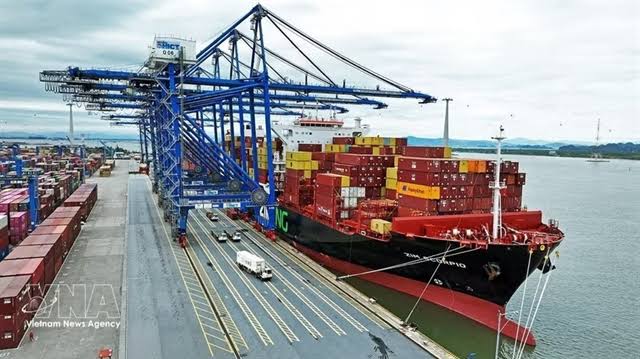
According to the Ministry of Industry and Trade, the country's total merchandise import and export turnover reached an estimated $1,010.6 billion between January and October 2026, registering a growth of 32.3 per cent compared with the corresponding period last year.
Exports stood at approximately $499 billion, marking a significant increase of 27.4 per cent year-on-year. In October alone, total trade turnover was estimated at $122.2 billion, representing a sharp growth of 47.6 per cent compared with October 2025.
The milestone comes nearly two decades after Vietnam joined the World Trade Organization in 2007, when its annual trade volume was just over $100 billion. The latest figures underline the country's rapid integration into the global economy and its emergence as an important manufacturing and export destination.
Industrial manufacturing has remained the principal driver of export growth. Processed and manufactured industrial products accounted for 87.4 per cent of Vietnam's total export turnover during the first 10 months. Both domestic companies and foreign-invested enterprises contributed to the expansion, with exports recording positive growth across major markets, including China, the United States, the European Union, South Korea and ASEAN countries.
Electronics, computers, telecommunications equipment, machinery and other manufactured products continue to play a significant role in Vietnam's export economy. The country's participation in international production networks has strengthened its position as an alternative manufacturing destination for global companies seeking to diversify supply chains.
Foreign direct investment has also supported the expansion. Registered FDI reached approximately $50.36 billion during the first 10 months of 2026, an increase of 76.4 per cent year-on-year, while disbursed investment totalled $21.07 billion, up 12.1 per cent. A substantial share of investment has been directed towards processing, manufacturing, electronics and technology-related industries.
Despite the strong export performance, Vietnam continues to face challenges in maintaining a balanced trade position. The country recorded an estimated trade surplus of $6.8 billion in October, marking the second consecutive month of surplus. However, the cumulative trade deficit for the January-October period stood at approximately $12.7 billion, according to the Ministry of Industry and Trade.
The government is now focusing on improving the quality and sustainability of trade growth by increasing the participation of domestic businesses in export-oriented industries. The Ministry of Industry and Trade is preparing a new import-export strategy through 2030, with a vision extending to 2045.
Under the proposed strategy, Vietnam aims to achieve average annual export growth of 15-16 per cent and import growth of 12-13 per cent during 2026-2030. The country also intends to increase the share of domestic enterprises in total exports to around 28-30 per cent by 2030, compared with the current level.
The strategy places particular emphasis on increasing the domestic value addition of exported products, strengthening technological capabilities, expanding manufacturing capacity and diversifying international markets. Processed and refined products are targeted to account for 89-90 per cent of total exports by 2030, while high-technology products are expected to represent around 50 per cent of processed and manufactured exports.
Vietnam is also looking to reduce its dependence on a limited number of trading partners. Its proposed strategy aims to ensure that no single export market accounts for more than 25 per cent of total exports by 2030. The government is also seeking to expand trade with emerging markets in South Asia, the Middle East, Africa and Latin America.
For the remainder of 2026, the government has identified export promotion, effective utilisation of free trade agreements, market diversification and improved compliance with international trade standards as key priorities. It also plans to strengthen cold-chain logistics, improve agricultural export infrastructure and help domestic companies meet international requirements relating to product quality, traceability and rules of origin.
Vietnam's record trade performance highlights the growing importance of Southeast Asia in global commerce at a time when multinational companies are diversifying manufacturing bases and reassessing international supply chains. However, converting the expansion in trade into higher domestic value addition and stronger participation by local enterprises remains a key challenge for the country's long-term economic strategy.