
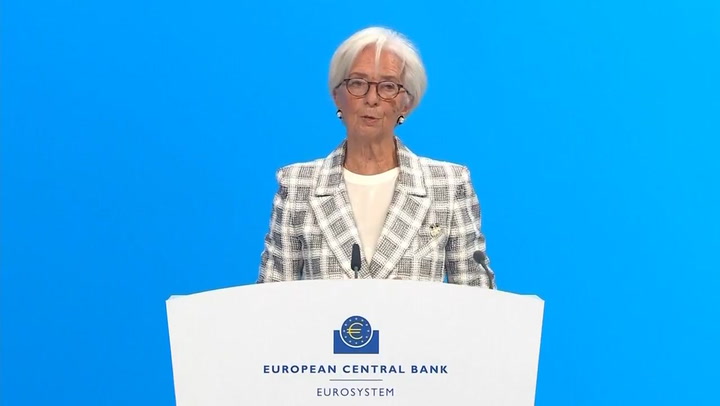
NEW DELHI: European Union leaders are preparing to select the next president of the European Central Bank (ECB), with the appointment process gaining importance ahead of the scheduled end of Christine Lagarde's term in February 2027. The selection is expected to be a significant decision for the eurozone, as the incoming chief will oversee monetary policy at a time when European economies continue to face challenges related to inflation, economic growth, borrowing costs and global financial uncertainty.
Lagarde, who took charge of the ECB in November 2019, is serving an eight-year, non-renewable term. Her departure is scheduled for February 7, 2027. The next president will be responsible for steering the eurozone's monetary policy, maintaining price stability and guiding the central bank's response to changing economic conditions across the 20 countries that use the euro.
The Netherlands has formally announced its intention to nominate former Dutch central bank governor Klaas Knot for the position. Knot headed De Nederlandsche Bank from 2011 to 2025 and served as a member of the ECB's Governing Council, giving him extensive experience in European monetary policy. Spain is also expected to nominate Pablo Hernández de Cos, the current general manager of the Bank for International Settlements (BIS) and former governor of the Bank of Spain from 2018 to 2024. Both candidates have significant experience in central banking and international financial institutions.
Eurozone governments have been asked to submit their nominations by November 6, while finance ministers are scheduled to review the candidates during the Eurogroup meeting on November 9. However, ministers are not expected to announce a final selection at this meeting. The discussions will focus on assessing the nominations and building consensus among member states before a formal recommendation is made.
Under the European Union's appointment procedure, the selection of the ECB president involves several institutional stages. The Eurogroup discusses the proposed candidates, following which the Council of the European Union recommends a candidate to the European Council. The European Parliament and the ECB's Governing Council are then consulted before EU leaders take the final decision. The appointment requires support from at least 16 of the 21 eurozone countries, representing at least 65 per cent of the bloc's population.
The leadership transition could also form part of a broader reshuffle within the ECB's Executive Board. Two other senior positions are expected to become vacant in 2027: Executive Board member Isabel Schnabel is due to leave on January 3, while Chief Economist Philip Lane's term is scheduled to end on May 31. EU governments may therefore seek to coordinate the appointments as part of a wider political agreement over representation within the central bank.
The December 17–18 European Council summit is the preferred target for completing the appointment, although officials have indicated that the process could extend into January 2027 if consultations and political negotiations take longer than expected. The choice will have implications for the future direction of monetary policy in the eurozone, particularly as the ECB continues to balance inflation control, economic growth and financial stability