
NEW DELHI: Kyndryl, a leading provider of mission-critical enterprise technology services, today released the findings from its third annual Readiness Report, revealing a widening divide between the returns organizations are seeing from AI and their readiness to manage the risks and demands that come with it.
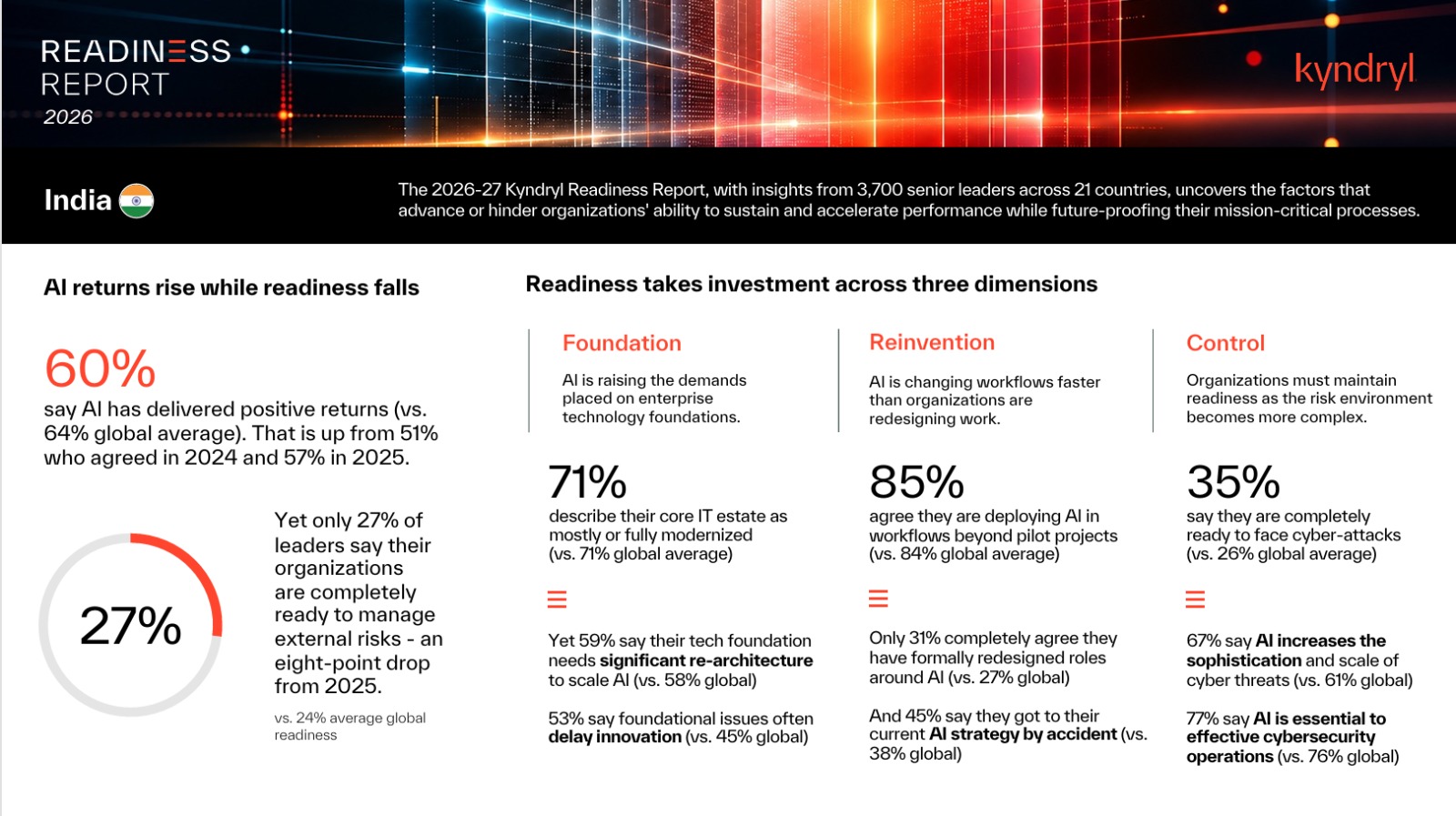
While 60% of Indian leaders report positive returns on AI investments, up three percentage points from 2025, average readiness across external risks fell eight points to 27%. The findings highlight growing challenges around technology foundations, organizational transformation and risk management as AI adoption accelerates.
This year’s report captures the attitudes and actions of 3,700 senior business leaders across 21 countries including 200 in India. The data shows a dichotomy: while organizations are racing to deliver returns on significant AI investments, they simultaneously feel ill-equipped to navigate the implications of an AI-forward economy.
“As AI creates significant opportunity, organizations are now focusing on how to make early returns sustainable,” said Martin Schroeter, Chairman and CEO, Kyndryl. “This year’s Readiness Report shows a new kind of readiness gap: AI ambitions are moving faster than the systems needed to support them, and the bar for readiness keeps moving as AI becomes more integrated in enterprises. Our data shows that focusing on people, technology, and governance can help organizations win with AI and keep the ability to adapt as opportunities evolve.”
The report shows that Indian organizations are making progress in moving AI beyond experimentation, with 85% deploying AI in workflows beyond pilots, while the share still in the experimentation stage has declined 15 percentage points to 56%.
However, scaling remains a challenge, with 70% reporting more AI pilots than they can realistically scale and 58% saying innovation often stalls after proof of concept. As a result, 50% have significantly changed their AI strategy in the past year, while 31% have experienced an AI investment failure. Further, 37% report CHRO and CTO/CIO disagreement on AI strategy, highlighting gaps in organizational alignment.
Additional findings from the report include:
Security concerns drive down confidence
For the third year in a row, security concerns topped the list of external risks, and this year contributed most to the overall decline in readiness. Just 35% of Indian organisations and 26% of organisations globally said they were completely ready to manage cyberattacks, marking a decline of 10 and 11 percentage points, respectively, compared to last year.
Three in four leaders say AI helps their organizations identify threats faster, even as confidence in their ability to respond to cyberattacks has declined.
Concern about AI challenges established business models
The second-largest drop in readiness came from global leaders’ concerns about competitive disruptions outside of their industry (-10 points from 2025, to 23%). The finding comes as AI agents and other new technologies are being deployed to erode established industry boundaries, and leaders described both challenges of adopting new technologies to questioning established products and business models.
The shift is already visible in enterprise operations, with 85% of Indian organisations deploying AI in workflows beyond pilot projects and 80% using AI agents to automate workflows previously requiring coordination across multiple teams or systems.
Retailers, for instance, are weighing how to benefit from AI shopping assistants without forfeiting direct customer relationships; software companies face questions about SaaS models as AI rebalances the build-versus-buy equation; and financial institutions are challenged by emerging lending models.
Modernized infrastructure isn’t necessarily AI-ready
For the third year in a row, Indian leaders said upgrading their IT infrastructure was the number one action their organizations are taking to mitigate external risks, and 71% rate their infrastructure as mostly or fully modernized. 59% of Indian leaders say significant re-architecture is required to support AI at scale. Leaders are also making a distinction between a modern IT estate and one ready for artificial intelligence.Bengaluru, November 11: Indian organisations are increasingly generating positive returns from artificial intelligence (AI) investments, but their preparedness to manage the associated risks is declining, according to the third annual Readiness Report released by Kyndryl, a provider of enterprise technology services.
The report found that 60 per cent of Indian organisations investing in AI and machine learning reported positive returns, marking an increase of three percentage points from 2025. However, the average readiness of Indian organisations to manage external risks declined by eight percentage points to 27 per cent, highlighting a growing gap between AI adoption and organisational preparedness.
Based on a survey of 3,700 senior business leaders across 21 countries, including 200 respondents from India, the report highlights challenges related to cybersecurity, infrastructure modernisation, workforce alignment and the ability to scale AI initiatives.
AI adoption is gaining momentum in India, with 85 per cent of organisations deploying the technology in workflows beyond pilot projects. At the same time, the proportion of organisations still in the experimentation stage declined by 15 percentage points to 56 per cent.
However, scaling AI initiatives remains a significant challenge. Around 70 per cent of Indian organisations reported having more AI pilot projects than they can realistically scale, while 58 per cent said innovation frequently stalls after the proof-of-concept stage. The report also found that 50 per cent of organisations had significantly revised their AI strategies over the past year, while 31 per cent had experienced an AI investment failure.
Organisational alignment is another concern, with 37 per cent of respondents reporting disagreements between chief human resources officers (CHROs) and chief technology or information officers (CTOs/CIOs) over AI strategy.
Commenting on the findings, Martin Schroeter, Chairman and CEO of Kyndryl, said organisations were increasingly focusing on making early returns from AI investments sustainable. He noted that AI ambitions were advancing faster than the systems required to support them, making investment in people, technology and governance essential for long-term success.
Cybersecurity emerges as a major concern
For the third consecutive year, security concerns remained the leading external risk for Indian organisations. Around 68 per cent of respondents identified cyberattacks as a major external concern, while only 35 per cent said their organisations were completely prepared to manage such threats.
The corresponding global figure for complete readiness stood at 26 per cent. The proportion of organisations reporting complete preparedness declined by 10 percentage points in India and 11 percentage points globally compared with the previous year.
Despite declining confidence in their ability to respond to cyberattacks, nearly three out of four business leaders said AI was helping their organisations identify security threats more quickly.
AI disruption challenges traditional business models
The report also highlighted growing concerns about AI-driven competition and disruption across established industries. Globally, readiness to manage competitive disruptions originating outside organisations' traditional industries declined by 10 percentage points to 23 per cent.
In India, 80 per cent of organisations reported using AI agents to automate workflows that previously required coordination across multiple teams or systems. The growing adoption of AI agents is prompting businesses to reassess established operating models, products and customer relationships.
Infrastructure modernisation remains a priority
Indian organisations continue to prioritise IT infrastructure upgrades to manage external risks. Around 71 per cent of business leaders rated their infrastructure as mostly or fully modernised. However, 59 per cent said significant re-architecture would still be required to support AI deployment at scale.
The findings underline that modernising IT infrastructure alone may not be sufficient to ensure AI readiness. Organisations will also need to strengthen cybersecurity, improve governance, align leadership strategies and develop the capabilities required to integrate AI into business operations.
The report concludes that while Indian enterprises are increasingly realising the business benefits of AI, sustained returns will depend on their ability to address infrastructure limitations, manage emerging risks and build organisational readiness.