
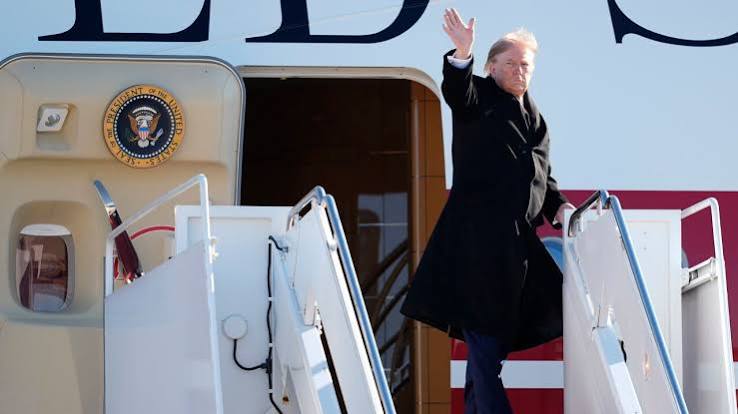
NEW DELHI: US President Donald Trump's ongoing Asia tour is emerging as a significant diplomatic test for Washington, with discussions involving India, Japan, Australia, China and Russia expected to shape the region's geopolitical and economic landscape. The visit comes at a time of growing strategic competition, uncertainty over global trade and continuing conflicts in Ukraine and the Middle East.
Trump's arrival in Manila on Tuesday marks the beginning of a series of high-level engagements, including the first Quad leaders' meeting in two years. Prime Minister Narendra Modi, Japanese Prime Minister Sanae Takaichi and Australian Prime Minister Anthony Albanese are expected to join Trump for discussions on Indo-Pacific security, maritime cooperation, critical minerals, artificial intelligence and supply-chain resilience.
The timing of the Quad meeting is particularly significant as Washington prepares for a separate engagement with Chinese President Xi Jinping. The grouping, comprising India, the US, Japan and Australia, is seeking to strengthen regional cooperation at a time when China's growing economic and military influence continues to shape strategic calculations across the Indo-Pacific.
However, Trump's approach towards Beijing remains a key factor in the region's diplomatic equation. While Washington has emphasised the importance of maintaining strategic partnerships with its Asian allies, the US administration is also seeking to preserve a fragile trade understanding with China and address disagreements over technology exports and critical supply chains.
The diplomatic stakes will rise further during Trump's planned visit to Shenzhen for the Asia-Pacific Economic Cooperation forum, where discussions with Xi and Russian President Vladimir Putin are expected to draw international attention. The proposed trilateral engagement could provide an opportunity to discuss the Ukraine conflict, nuclear arms control, international security and broader geopolitical tensions.
Trump's domestic political position also adds another dimension to the visit. His Republican Party's defeat in the US midterm elections has raised questions about his political leverage and the extent to which domestic opposition could influence his foreign policy decisions, particularly on trade and relations with China.
For India, the Quad meeting offers an opportunity to reinforce its strategic role in the Indo-Pacific while maintaining diplomatic and economic engagement with multiple global powers. New Delhi's emphasis on a free, open and inclusive Indo-Pacific also reflects its interest in ensuring regional stability without allowing geopolitical competition to disrupt economic cooperation.
The broader significance of Trump's Asia tour lies in the challenge of balancing competing priorities. Washington must reassure its regional allies, manage economic competition with Beijing and explore diplomatic avenues with Moscow, while avoiding further escalation of existing conflicts.
The outcome of these engagements could offer important indications of the future direction of US foreign policy and the evolving balance of power in the Indo-Pacific. At a time when international relations are increasingly shaped by strategic competition and economic interdependence, the ability of major powers to maintain dialogue while managing their differences will remain critical to global stability.